
Applying for a marriage-based green card can feel overwhelming. There are multiple forms, deadlines, and government rules to follow. One mistake with your paperwork can lead to delays or even denials. The good news is that if you know exactly what documents you need, the process becomes far more manageable.
This guide breaks down the key documents needed to apply for a green card through marriage, explains why they matter, and shows you how to prepare a strong application from the start.
Read more: What are the Fastest Ways to Get a Green Card?
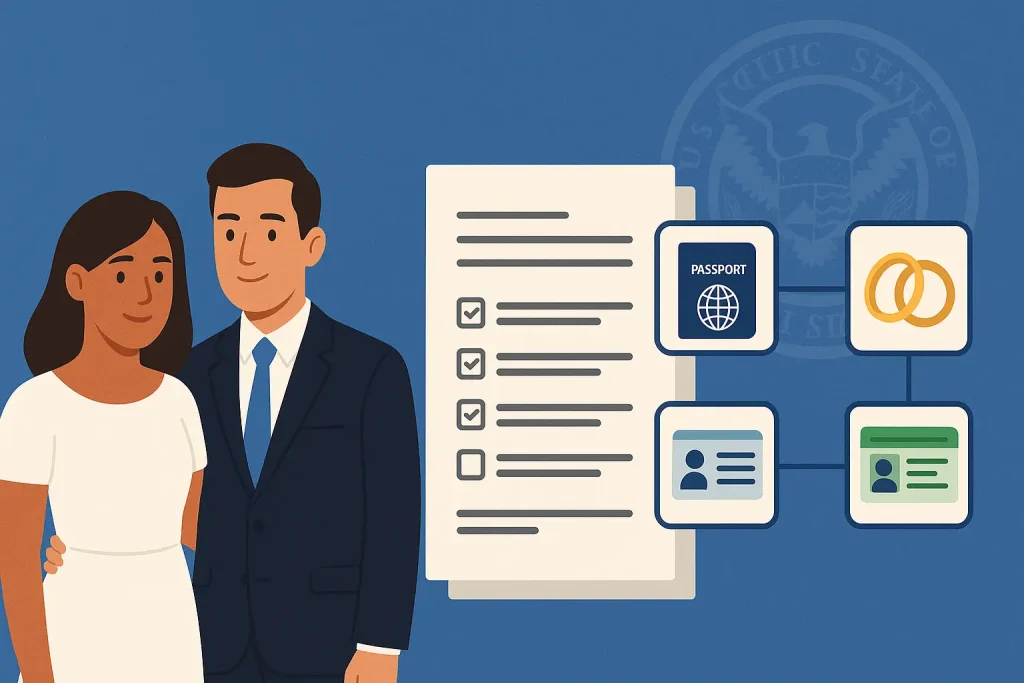
Your marriage-based green card application requires a mix of personal, legal, and financial documents. Depending on whether you are applying from inside the U.S. (adjustment of status) or outside the U.S. (consular processing), the checklist may vary slightly. Here are the green card through marriage requirements.
These items prove that your marriage is genuine, not just for immigration purposes.
This is the first step in showing USCIS that your relationship qualifies for a green card.
If you are already in the U.S., you’ll typically file Form I-485 alongside Form I-130. Supporting documents include:
If you’re outside the U.S., you’ll go through consular processing. This means submitting the DS-260 form online and preparing:
| Document Type | Adjustment of Status (I-485) | Consular Processing (DS-260) |
| Marriage Certificate & Proof | ✓ | ✓ |
| Form I-130 & Proof of Sponsor | ✓ | ✓ |
| Passport-Style Photos | ✓ | ✓ |
| Birth Certificate & Passport Copy | ✓ | ✓ |
| Proof of Entry (I-94, Visa, etc.) | ✓ | — |
| Form I-864 (Affidavit of Support) | ✓ | ✓ |
| Medical Exam (I-693) | ✓ | — (done abroad) |
| DS-260 Form | — | ✓ |
This table helps you see at a glance what’s required depending on your situation.
Submitting a complete, organized packet reduces the chances of a Request for Evidence (RFE) and keeps your case moving forward.
Even small errors can delay your green card approval.
The green card process involves multiple forms, deadlines, and document requests. Staying organized not only saves time but also helps you avoid unnecessary delays.
Start by creating a dedicated folder (physical or digital) for your application. Keep all required documents, receipts, and notices in one place. This way, you’ll always have quick access when USCIS or the National Visa Center (NVC) asks for additional proof.
It also helps to prepare a checklist tailored to your case. For example, if you’re applying through adjustment of status, your checklist will look slightly different than if you’re applying through consular processing.
Set reminders for important steps like medical exams, biometrics appointments, and filing deadlines. Missing these can cause months of delay. Simple calendar alerts on your phone can keep you on track.
Finally, don’t be afraid to ask for professional help. Many applicants choose to work with an Arizona immigration attorney who can review their packet before submission. A second set of eyes can catch missing documents or errors that might lead to a Request for Evidence (RFE).
Getting your marriage-based green card is too important to risk with incomplete documents. The sooner you prepare correctly, the smoother your case will go.
📞 Call Big Chad Law at (602) 560-5820 for a free consultation with an Arizona immigration attorney. Let us help you avoid mistakes and get the outcome you deserve.
No. Submit copies unless USCIS specifically requests originals. Bring originals to your interview.
Yes, if you are in the U.S. and your spouse is a U.S. citizen. This is called concurrent filing.
Yes, having an attorney on your side can help you avoid costly mistakes, file the correct forms, and strengthen your case for approval. At Big Chad Law, we guide spouses through every step and make sure all your documents are complete and accurate.
USCIS may issue a Request for Evidence (RFE). This delays approval, so submit a full packet from the start.
Anywhere from 10 months to 2 years, depending on your case type, USCIS backlog, and whether you’re applying inside or outside the U.S.
Adjustment of Status (in the U.S., filing I-485): identity (passport), birth certificate, proof of lawful entry (I-94/visa), two photos per form instructions, I-864 Affidavit of Support + evidence, I-693 medical (sealed), and any required status documents.
Consular Processing (abroad, DS-260): valid passport, civil documents (birth, marriage, police certificates as required by country), I-864 + evidence, photos, and interview appointment materials.
Key takeaway: Build two piles: identity/status/medical/financial for AOS; civil docs/financial for consular. Cross-check each form’s instructions.
No—USCIS expects bona-fide marriage evidence beyond the certificate. Include joint lease/deed, joint bank/credit accounts, insurance policies naming each other, children’s birth certificates, photos, travel records, and affidavits. USCIS lists examples in policy and form guidance.
Key takeaway: Show shared life (housing, money, insurance, kids, history) — not just a ceremony.
Proof that the sponsor meets the income threshold (generally 125% of HHS poverty guidelines). Provide the most recent tax return/IRS transcript, W-2/1099, recent pay stubs, and/or employment letter; assets or a joint sponsor are options if income is short. Check the current HHS chart (I-864P).
Key takeaway: If income < guideline, add assets or joint sponsor and document them thoroughly.
Yes for AOS; submit the sealed I-693 either with the I-485 or later (e.g., at interview or in response to an RFE). USCIS guidance covers validity and submission options; forms signed on/after Nov 1, 2023 have updated validity rules tied to the I-485 per 2025 policy.
Key takeaway: Use a USCIS civil surgeon, keep the sealed envelope, and follow the current validity policy.
File photocopies unless the instructions/regulations say otherwise; bring originals to the interview. Any non-English document must include a certified English translation (translator certifies completeness/accuracy and competency).
Key takeaway: Copies to file, originals to show; every non-English doc needs a certified translation.